
 Send Inquiry

What Is a Backhoe? A Complete Beginner’s Guide
Contents
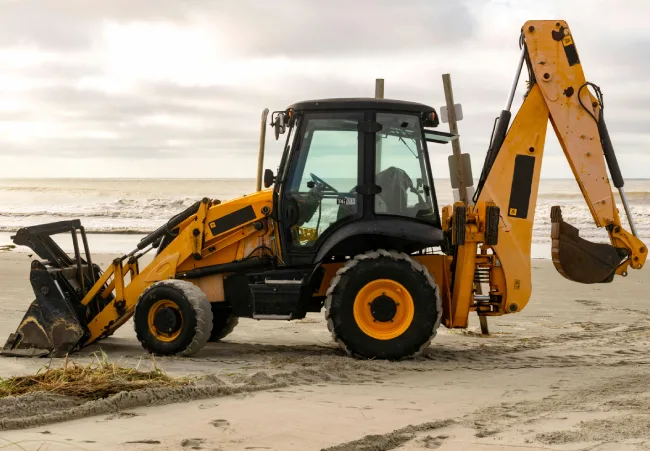
What is a backhoe? A backhoe is also known as a backhoe loader or backhoe excavator. It combines the digging function of a hydraulic excavator and the loading function of a loader. With a loading bucket at the front and a digging device at the rear, the backhoe is capable of loading materials and excavating soil. It achieves the dual functionality of one machine. Below is what a backhoe looks like.

Types of Backhoe
| Classification Dimension | Backhoe Types |
| Structurally | With side transfer frame, without side transfer frame |
| Driving mode | Two-wheel (rear-wheel) drive, four-wheel drive |
| Frame | Articulated type, integral type |
| Moving style | Crawler type, tire type |
What Is a Backhoe Used For?
The backhoe loader is frequently used in places where both excavation and material handling are required simultaneously. At these sites, it can fully show its greatest advantage – the excavating end for excavation and crushing, and the loading end for loading and earthmoving tasks. This significantly boosts efficiency.
For example, when digging a trench to establish a drainage system, although compact machinery like a wheeled mini excavator and a small loader can handle such tasks, a backhoe loader can replace both with just one machine. The operator only needs to swivel the seat to switch between the working ends. The working efficiency is greatly increased.
If you needs to carry out both excavation and loading operations, the backhoe loader is the best choice for these tasks. It will save you a great deal of time and cost.
What Are Backhoe Buckets?
On the front loading part of the backhoe loader, a standard earthwork bucket can be equipped. It can also be equipped with multi-functional buckets, such as the 4-in-1 bucket and the 6-in-1 bucket.
If the work content is more diverse, such as both loading materials and leveling and cleaning, a multi-functional bucket is more suitable.
Backhoe Loader Parts and Functions
Backhoe Loader Parts
Backhoe loaders are mainly composed of an engine, a transmission, a drive axle, a hydraulic system, an electrical control system, a working device, and other auxiliary components.
| Components | Description |
| Engine | Most are turbocharged diesel engines, with high power and energy-saving, fuel-efficient. |
| Transmission | Mostly use hydraulic shift transmissions. Equipped with a reversing device, enabling steering during forward movement. |
| Drive axle | Equipped with braking mechanisms. Two types: vacuum-assisted wet braking and full-hydraulic wet braking. |
| Hydraulic system | Adopt quantitative and variable systems. The variable system has lower heat generation than the quantitative system, with obvious advantages. |
| Electrical system | Uses waterproof and dustproof design, and uses high-strength wires and sealed electrical plugs. |
| Working device | Generally adopt an eight-link mechanism, with mechanical leveling or hydraulic leveling mechanisms. The loading bucket mostly uses a 4-in-1 bucket, and can also be selected as a 6-in-1 bucket. |
| Excavating devices | Side-shifting type and central-axis type. The side-shifting type excavating device can move left and right on the frame, while the central-axis type excavating device cannot do that. |
| Excavating boom | Curved-arm type and straight-arm type. The curved-arm structure is similar to that of an excavator. |
| The cab | It generally adopts negative pressure design to reduce dust entry. To provide the operator with sufficient safety protection, a roll-over/falling object protection (ROPS/FOPS) cab is used. |
Backhoe Loader Functions
Backhoe Advantages and Disadvantages
Core Advantages
Dual-purpose in one machine, integrated functions
Multi-attachment compatibility and wide range of working scenarios
Quick maneuvering and high traffic efficiency
Compact structure, strong adaptability
Convenient operation, efficient switching
Lower overall investment cost
Main drawbacks
●Due to structural limitations, in pure loading or pure digging conditions, the operational efficiency compared to dedicated loaders and excavators has a certain gap in terms of fuel economy.
●The overall length of the machine is quite long. It adopts front-wheel steering, and the turning radius is relatively larger. The positioning accuracy of the bucket is slightly inferior compared to that of articulated loaders.
●The excavation operation end cannot rotate 360 degrees, and its mobility is limited during operation. Compared with wheel-type excavators, its operational range is limited.
●Some power-driven attachments have relatively high installation and matching requirements. In actual use, they are mostly used in situations such as crushing and simple lifting.

What Is a Backhoe vs Excavator?
If you only care about the excavation function, the backhoe is not as good as the excavator. If you care about the loading function only, the backhoe is not as good as a loader either.
However, the real advantage of the backhoe lies in its versatility — it combines both functions in one machine. You can think of it as an equivalent to a 7.5-ton excavator plus a 3-ton loader in a single unit. So, choose the suitable equipment according to your working conditions!
If you’d like a deeper dive, feel free to check out our blog – Backhoe vs Excavator
YUFAN 2026 Innovative Backhoe Loader
The 2026 series of backhoe demonstrates superior performance in terms of loading and excavation efficiency, as well as the attachment uses extension. YUFAN engineers has innovatively optimized the traditional dual-function frame, excavation working device, transmission system, and steering system.

Bidirectional Driving Technology
The new control platform puts the steering, gear shift, throttle, brake, joystick, display, and switches on one rotating base. This allows the machine to drive in two directions.
When working on the digging side, the operator can still move, change gears, and brake easily, just like operating a wheeled excavator. It is flexible and efficient.
Digging End 230° Rotation Technology
Traditional backhoe machines use a rotation cylinder to drive the working device to rotate. It can only turn 180°. This is very inconvenient in working in narrow conditions.
The new model uses a swing motor and bearing, and can rotate up to 230°. This makes work easier, especially in small or crowded areas.
Hydrostatic Drive Technology
Hydrostatic drive technology is widely used in loaders, but it has not been applied to backhoes. The new model uses a single pump, single motor and two-speed gearbox as its transmission components
Four-Wheel Steering Technology
The front axle and rear axle of the new dual-function machine are steering drive axles, and they are combined with a hydraulic switching valve to achieve three steering modes: two-wheel steering, four-wheel steering, and crab-shaped steering.
During loading operations, using four-wheel steering and the hydrostatic drive technology, it becomes an efficient loader. During high-speed transfer, using two-wheel steering, the steering is precise and the stability is good. In special situations, using the selected crab-shaped steering mode meets the requirements of special terrain and passages.
Would you like to know more about the configuration and quotations of backhoes? Please contact YUFAN Machinery. We will provide you with professional selection plans and considerate services.

Posted by Isabel leave words
Thanks for reading. I hope my article helps. Please leave a comment down below. You may also contact YUFAN online customer representative for any further inquiries.
 English
 Arabic
 Chinese (Simplified)
 Dutch
 French
 Italian
 Portuguese
 Russian
 Spanish
Leave a Reply