
 Send Inquiry

How to Import Excavator from China? Real Case
Contents
Whether you are in the United States, Canada, the United Kingdom or Belgium, importing excavators from China generally does not require too many procedures. A reliable excavator supplier will do their best to reduce your customs clearance costs, saving you both time and effort.
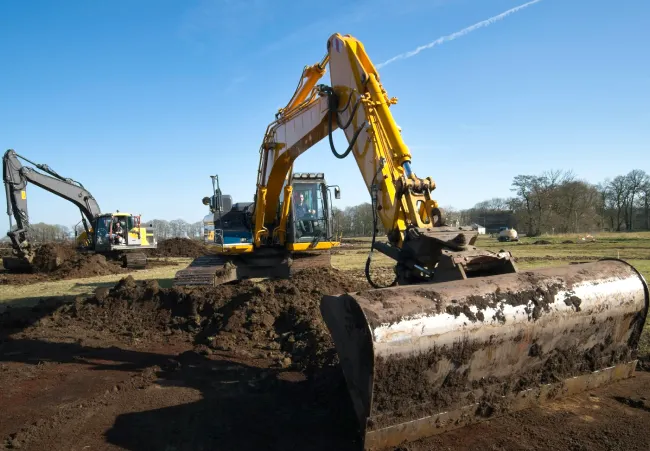
This article uses the specific example of the excavator factory YUFAN Machinery to help you understand the process of importing excavators from China more clearly.
How to Choose A Reliable Excavator Supplier in China?
Clearly Know Your Own Requirements
First, clearly know the type and specifications of your required excavator. What tonnage do you need? Your required digging depth? Bucket capacity? Engine emission standard (it needs to meet the emission standards of your country).
Search for a Reliable Chinese Supplier
There are various ways to find a reliable Chinese supplier. Below are some common ways to help you locate.
1. Go purchasing platforms such as Alibaba and Made in China
2. Search for source factories on Google (lower cost, no middlemen)
3. Know the schedule of local mechanical trade fairs, and you can make a plan to participate in them
4. Partner with a purchasing agent (less effort and worry, but price is higher)
Finding a reliable manufacturer in China is as important as choosing the right excavator. Here are the methods to help you determine whether a Chinese supplier is reliable.
| Verify Items | What the Supplier Should Provide / Clarify |
|---|---|
| Business License & Certifications | Business License, CE, ISO, Emission Certifications |
| Factory Strength | On-site workshop photos, photos of the production line, export country cases, and whether communication is professional. |
| Service & Warranty Policy | Excavator warranty period? Does the supplier provide spare parts or technical support? If the equipment is damaged, who is responsible for after-sales issues? |
| Inspection | Confirm with the factory whether you will conduct video inspection or on-site factory inspection (Some China factories, such as YUFAN, will cover the customer’s round-trip airfare and accommodation costs). Once satisfied, complete full payment and confirm shipping details. |
| Red Flags | Supplier red flags: • Refuses to provide required documents • Pressures you to make payments outside a secure platform • Cannot clearly explain the entire manufacturing and delivery process • Lacks international shipping records |
Follow-up Operations After Confirming A Supplier
1. Negotiate the terms and sign the contract
✅ After selecting the supplier, confirm the payment method with the salesperson, which is usually T/T (30% advance payment, and 70% balance payment to be paid before delivery), and other methods include letter of credit, OA, DP, etc.
✅ Confirm the trade terms, such as EXW, FOB, CIF or CFR, and choose the transportation method (most cases by shipping) and insurance to protect the equipment.
2. Prepare imported documents
Common documents include bill of lading, commercial invoice, packing list and certificate of origin. Besides these standard documents, also check the import regulations of your region to see if there are any special documents or licenses.
3. Select the correct transportation method for small excavators
No matter shipping to the United States, Canada, Belgium or the United Kingdom, shipping by sea is usually the most economical transportation method for transporting excavators from China. The delivery time is generally 25-35 days.
▪️Small or mini excavators – Container transportation
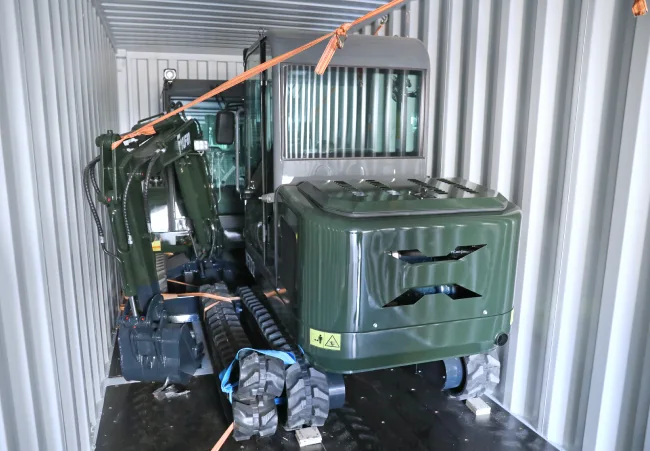
If the small excavators weigh less than 6 tons, 20ft containers are the most economical option. For excavators weighing between 6 tons and 20 tons, use 40ft containers (the manufacturer will help to arrange them). This way, they can better withstand weather and theft during the shipping process.
▪️Large excavators – Flat rack transportation
This method is most suitable for excavators weighing 20 tons or more. It will secure the large excavator on an open platform.
4. Understand customs clearance procedures
Before your excavator arrives at the customs, please ask the supplier to provide the following documents to you:
▪️Commercial invoice (indicating the value, description and HS code of the equipment)
▪️Packing list
▪️Bill of lading (for sea transportation)
▪️Certificate of origin
▪️Environmental compliance certificate (applicable to countries requiring EPA standards)
5. Import duties and taxes
The customs duties you pay are usually based on the HS code, trade policies, etc. Different countries have different customs duty rates. For example:
| Country | Customs Duty Rate (as of Jan 2026) |
|---|---|
| America | 50% |
| Canada | 35% |
| Belgium | 21% |
| UK | 20% |
Real Case: Transporting 8 Small Excavators from China to Canada
To better understand the transportation process, the following describes how a Canadian customer of YUFAN successfully imported 8 small excavators to the province of Quebec in Canada. If you have the demand for importing excavators from China, just have a reference.
I. Pre-import Preparation
This Canadian client found YUFAN Machinery in Google and communicated with our sales Shannon Zhao to confirm we can meet all of their requirements.
The client Eric clarified his own requirements as below:
1️⃣ The model and quantity of the excavators
2️⃣ Special requirements – Canadian EPA engine certification, exclusive customs clearance documents, bill of lading, neutral nameplate, customized white logo, etc.
3️⃣ Core details of the order, including equipment model, customization standards, gifts (the 1.8T excavator ordered by this Canadian client is free of charge with a plastic roof, toolbox, filter, and manual), price, payment method (including the payment node for the final installment).
Please contact the local customs clearance agency in Canada in advance to understand the mandatory requirements for importing excavators, such as EPA engine certification, document filing, accessory declaration norms, etc. This will help you gain a clear understanding and avoid subsequent customs clearance issues.
II. Tracking Orders
Once the order was confirmed with YUFAN, this client kept a close eye on his excavator production progressing. YUFAN agreed to provide regular updates. For example, when the machine painting was completed, when attachments were pre-installed. In this way, he could be sure everything was moving according to plan.
At the same time, he paid special attention to the customization details, like logo spraying, model markings, and neutral nameplates. Whenever something didn’t look quite right, he would flag it immediately and have YUFAN make adjustments.
When it came to the final payment, Eric took a cautious approach. Only after reviewing production updates, testing videos, and actual photos did he make the balance payment.
He also double-checked the accessories. He verified each required attachment and asked to be packed neatly into the storage cabinet before shipment.
III. Confirm Shipping Schedule
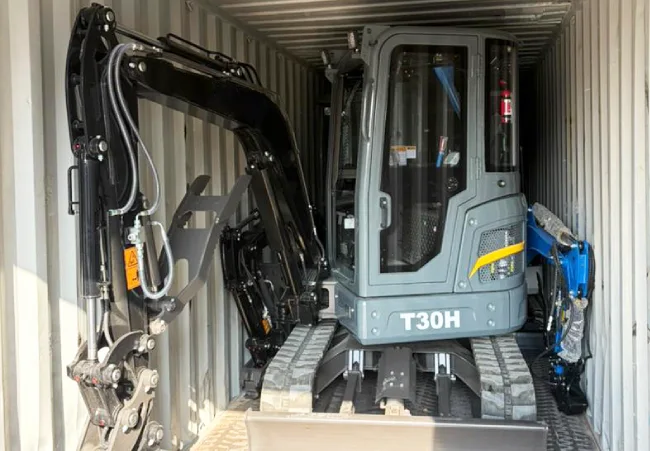
This client preferred to go with full container loading (FCL) under CIF terms. Together with YUFAN’s sales representative Shannon Zhao, he locked in the shipping date.
On the day of container loading, he asked for real-time photos of the process. This way, he could personally confirm that the machines were properly secured and protected.
YUFAN confirmed with Eric the exact receiving address. He also clarified an important document requirement: a Telex Release bill of lading instead of an original paper version, which would simplify customs clearance and pickup in Canadian port.
Once the vessel departure date was confirmed, Eric asked for a shipping notice along with the initial set of documents, so he knew the shipment was officially on its way.
IV. Follow Up on Documents & Prepare for Customs Clearance
After the shipment was dispatched, YUFAN sent over a full set of draft documents, including the bill of lading, packing list, commercial invoice, EPA certificates, and insurance policy. We informed the client to make sure everything was accurate.
Meanwhile, he coordinated with his local customs broker in advance. Key information such as the engine model and manufacturing date was shared early to ensure a smooth clearance process once the machines arrived.
When the official Telex Release bill of lading was issued, he confirmed it right away. This document is essential for both customs clearance and cargo pickup in Canada, so there was no room for error.
Before the shipment reached port, Eric did one final check to make sure all documents were complete and consistent—bill of lading, packing list, invoice, EPA certification, insurance, and even nameplate and engine filing records. With everything in order, he was fully prepared for the next step: customs clearance and delivery.
V. Kindly Reminder
1️⃣ For imported excavators to Canada, EPA engine certification is a mandatory requirement. Remember to confirm with the supplier in advance.
2️⃣ The electronic release bill of lading is extremely important! It is crucial for customs clearance and goods pickup in Canada. You need to follow up on the progress throughout the process.
3️⃣ All accessories (including gifts) must be listed separately with their value. Compliant declaration is necessary to avoid delays in customs verification due to improper declaration.
4️⃣ For any customized requirements (such as logos, nameplates), you need to follow up promptly for rectification, to avoid not meeting expectations upon arrival.
5️⃣ Establish dual-channel communication: Require the supplier to send key documents, loading photos, production inspection videos, etc. through both chat (such as WhatsApp) and email channels for easy record retention.
Summary
Importing small excavators from China is a smooth and economically efficient process, as long as you follow the correct steps and work with the right partners.
Are you planning to import small excavators from China?
Contact us and you can get a customized transportation quote today, or ask us how to transport small excavators from China to your destination.
CONSULT WITH OUR SALES

Posted by Isabel leave words
Thanks for reading. I hope my article helps. Please leave a comment down below. You may also contact YUFAN online customer representative for any further inquiries.
 English
 Arabic
 Chinese (Simplified)
 Dutch
 French
 Italian
 Portuguese
 Russian
 Spanish
Leave a Reply