
 Send Inquiry

Gradall vs Excavator: Key Differences, Pros & Which One to Choose
Contents
What Is a Gradall?
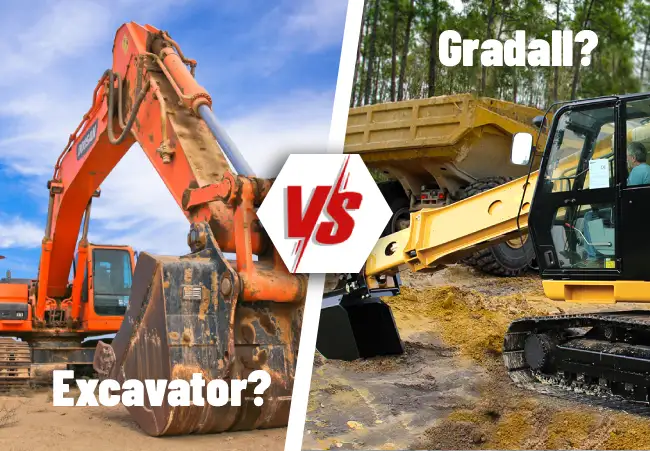
A gradall (also called telescopic boom excavator) does not use the traditional boom and stick of excavators, but is equipped with a telescopic boom similar to that of a crane, with the bucket directly installed at the top of the boom. Like hydraulic excavators, it is also driven by hydraulics to extend and retract, and can swing left and right over a wide range.

The gradall can significantly increase the working radius, depth and height. It is suitable for working conditions that traditional excavators cannot reach or enter. It is most proficient in fine operations such as municipal works, road maintenance, and river dredging.
Based on the way of walking, the gradalls have wheeled and tracked types. The wheeled type can directly travel on the road. Based on the structure, telescopic boom excavator is also divided into two types: sliding and nested boom designs. Compared with traditional excavators, telescopic boom excavators have higher work efficiency, and it can adapt to more complex working environments.
Gradall Telescopic Arm
The Gradall telescopic arm can be divided into two-section and three-section sleeve-type telescopic arm. The telescopic arm of the excavator can flexibly extend its working radius and vertical digging range. It is mainly used for deep subway entrances, construction of underground parking lots, and special well construction, etc.
Gradall Features
1. Large effective working distance and high working intensity. Through the structure of the telescopic arm, a longer intended distance can be achieved, and a higher working height can be reached through the change of the arm. This is incomparable to traditional excavators.
2. It can directly load and unload goods through some obstacles. With the telescopic arm device, it can perform loading and unloading operations across small ditches, steps, and doors and windows. By extending, shortening, and adjusting the angle of the telescopic arm, loading and unloading can be completed over long distances. The ditches at the machine stop surface can also be cleared, repaired, and leveled.
3. Gradall has good operational safety performance. When lifting heavy objects and carrying loads, the arm can still smoothly extend and retract, without tilting the vehicle or overturning. On uneven roads, by lowering the stabilizing legs to reinforce the body at the same time, it can prevent rollover.
Gradall Advantages
① It significantly increases the working distance of the excavator, and enhances its height. By changing the boom length, it can meet higher operational requirements.
② It is more flexible. It can work across various terrains and has a significant advantage in field operations.
③ The working safety has been greatly improved. When performing stacking operations in different environments, it can stay away from dangerous areas and use the telescopic function to complete the loading and operation of goods at a safe position.
④ It has multiple replaceable parts, and they can be replaced and substituted when necessary.

What is an excavator?
The ordinary excavator is of the articulated arm type. It features a classic three-section telescopic arm structure (the arm + bucket + bucket arm). It achieves actions such as digging, lifting, and unloading through the flexible bending of the joints.
The biggest difference between an ordinary excavator and a telescopic arm excavator is that, the arm of an ordinary excavator is foldable, while the arm of a telescopic arm excavator is straight and extendable, without an intermediate folding arm joint.
Gradall vs Excavator: Key Differences
Differences in Core Structure
| Comparison Item | Telescopic Boom Excavator (Gradall-type) | Conventional Excavator |
|---|---|---|
| Boom Structure | Straight telescopic boom design, extending and retracting linearly | Multi-section articulated boom, with folding joints |
| Chassis | Heavy-duty multi-axle wheeled truck chassis, excellent highway mobility | Tracked or wheeled chassis with low ground pressure |
| Swing & Rotation | Upper structure can slew, with the telescopic boom able to rotate ±220° | Upper structure provides full 360° slewing; the boom only bends, it cannot rotate independently |
Differences in Working Capabilities & Application Scenarios
| Comparison Item | Telescopic Boom Excavator | Conventional Excavator |
|---|---|---|
| Working Radius | 7–12 meters | 6-ton: 5–6 m 15-ton: 8–9 m 18-ton: 10–11 m |
| Digging Depth | Around 3.2 m, not designed for deep digging | 6-ton: 4.5 m 15-ton: 5.5 m |
| Narrow / Low-Clearance Work | Excellent performance, low-profile telescopic operation | Limited performance. Requires high overhead clearance |
| Digging Force | Consistent force throughout the reach, no significant drop-off | Significant force drop-off at large boom angles |
| Site-to-Site Mobility | Wheeled models can travel directly on public roads | Tracked models require transport trailer |
| Price | Higher initial cost | Standard, cost-effective |
| Core Strengths | Slope grading, ditch cleaning, lateral work, over-obstacle work | General excavation, deep trenching, heavy-duty digging |
| Versatility | Ideal for under-bridge, under-tree, low-clearance jobs | Limited in tunnels/under bridges |
| Multi-functionality | Supports various attachments, wide working range | Boom geometry limits some specialized tools |
Best Use Cases: Which One Should You Choose?
| Actual Working Conditions | Recommended Machine | Advantages | Not Suitable Scenarios |
|---|---|---|---|
| ▪️Working mainly on roads, municipal projects, roadside, under bridges, in tunnels ▪️Frequently moving between multiple sites, short-distance road travel ▪️Height-restricted working environments ▪️Primarily performing long-distance horizontal digging, ditch cleaning, and side work | Telescopic Boom Excavator | ▪️Wheeled chassis can travel directly on public roads, no trailer needed for site transfers ▪️Straight boom extends far horizontally, ideal for side, long-distance, and narrow work areas ▪️Digging force remains stable at long reach, no significant drop-off ▪️Low-profile operation avoids overhead obstacles, working in spaces conventional excavators cannot access | Not suitable for deep digging, hard soil/rock breaking, and large-scale earth loading |
| ▪️Working mainly on fixed sites: earthmoving, infrastructure, mining ▪️Focus on deep digging, foundation excavation, hard soil/rock breaking ▪️Open working space with no height restrictions ▪️High-volume earth loading and heavy-duty work | Conventional Excavator | ▪️Strong digging force, handles hard soil, weathered rock, and deep foundation work easily ▪️Large digging depth, efficient for foundation, deep trenches, ponds, and earth loading ▪️Tracked chassis provides good traction in mud, uneven terrain, and rough sites ▪️Large market availability, easy to find parts and low maintenance cost | Not suitable for low/narrow space work; requires a trailer for transport; digging force drops significantly at long horizontal reach |
If you have any questions about choosing between a gradall and a conventional excavator, feel free to consult us at YUFAN.
YUFAN is a professional manufacturer dedicated to construction machinery production. We tailor reliable equipment solutions and help every customer select the most suitable machines for their unique job sites.

Posted by Isabel leave words
Thanks for reading. I hope my article helps. Please leave a comment down below. You may also contact YUFAN online customer representative for any further inquiries.
 English
 Arabic
 Chinese (Simplified)
 Dutch
 French
 Italian
 Portuguese
 Russian
 Spanish
Leave a Reply